

Trump was the one who desperately pressured Pakistan for a ceasefire: FT report
Trump was the one who desperately pressured Pakistan for a ceasefire: FT report
US President Donald Trump was threatening to destroy Iran on one hand and claiming that Tehran was begging for a peace treaty to survive on the other. But behind the scenes, the White House was pushing for a temporary ceasefire.
The people involved said that the Trump administration had been pressuring Pakistan for weeks to convince Iran to stop the war and open the Strait of Hormuz. Since Pakistan is a Muslim country and a neighbor, Washington thought that Iran would easily accept the proposal if it was sent through them.
According to a report in the influential UK daily Financial Times (FT), Pakistan’s army chief General Asim Munir carried out this secret activity. As a result, the announcement of the two-week ceasefire on Tuesday night came. Interestingly, a few hours before this announcement, Trump had threatened that if he did not listen to him, he would destroy Iran’s entire ‘civilization’.
In fact, Trump was quite worried about the sharp increase in fuel prices. The way Iran resisted was also a surprise to him. Five reliable sources involved in the Pakistani mediation said that Trump had been desperate for a ceasefire since March 21.
As the deadline set by Trump was about to expire on Tuesday, Pakistan Army Chief Asim Munir repeatedly spoke to top officials including US Vice President JD Vance on the phone. He then spoke to Iran’s foreign minister and finalized the two-week proposal.
Pakistani Prime Minister Shahbaz Sharif made the announcement on the social media platform X (formerly Twitter). There, he claimed that it was Pakistan’s own initiative. But his post mistakenly left the word ‘draft’. This proves that the statement was actually written by the White House in advance.
In fact, Trump was quite worried about the sharp rise in fuel prices. In addition, the way Iran resisted was also a surprise to him. Five reliable sources involved in the Pakistani mediation said that Trump had been desperate for a ceasefire since March 21.
When Trump first set the deadline, General Asim Munir and senior Pakistani officials began to build bridges between Tehran’s leaders and the White House. They suggested that if there was a major peace meeting, it could be held in Islamabad.
The United States had proposed a 15-point draft proposal to end the war, which Pakistani officials showed to Iran. In return, Iran offered them 5 and 10 points in return.
In between, talks were held on ceasefires of varying durations, from 45 days to 2 weeks. Although both sides initially insisted on their demands, at one stage Iran agreed to reduce the amount of uranium it had stockpiled.
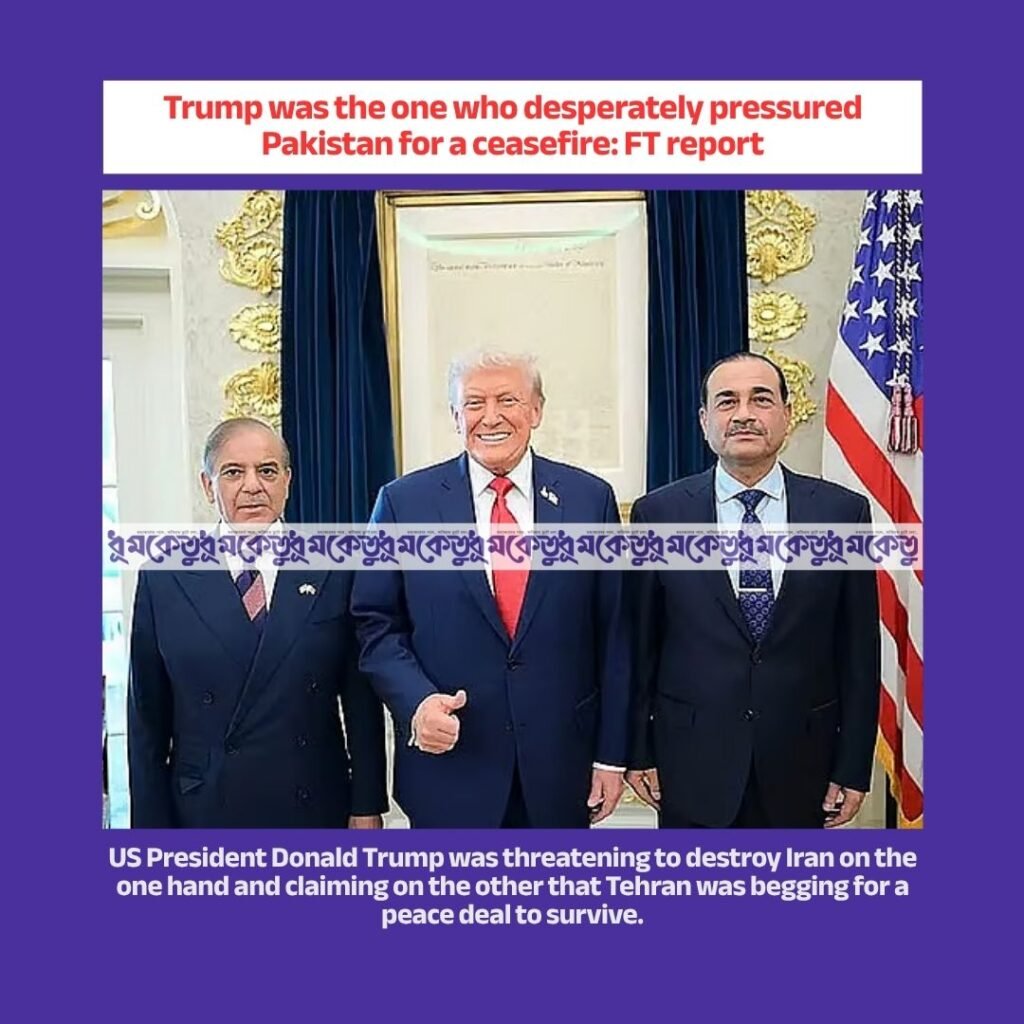
Pakistani Prime Minister Shahbaz Sharif and Army Chief Asim Munir met with US President Donald Trump. Oval Office, White House, Washington DC, September 25, 2025
Pakistani Prime Minister Shahbaz Sharif and Army Chief Asim Munir met with US President Donald Trump. Oval Office, White House, Washington DC, September 25, 2025 Photo: Pakistan Prime Minister’s Office/Courtesy of Dawn
After a week of major attacks by the United States and Israel, Iranian political leaders agreed in principle on one thing a few days ago. That is, a ceasefire in exchange for opening the Strait of Hormuz. But the problem arose with Iran’s most powerful force, the Islamic Revolutionary Guard Corps (IRGC). Convincing them was a big challenge.
There were also differences of opinion within the IRGC on this issue. A section of them was not willing to stop the war or give up control of the Strait of Hormuz in any way. Even last Tuesday, a drone attack was carried out in the Jubail area of Saudi Arabia. According to a Pakistani official, this was a last-ditch attempt to sabotage peace talks.
Since Pakistan has a military defense agreement with Saudi Arabia, Islamabad was very angry about this attack. They made it clear to Tehran that if such attacks continue, all peace efforts will be ruined and Iran will be isolated from the rest of the world.
It is worth noting that despite repeated attacks on Saudi Arabia, Pakistan has tried its best to remain neutral in this war from the beginning.
After a week of major attacks by the United States and Israel, Iranian political leaders agreed in principle on one issue a few days ago. That is, a ceasefire in exchange for opening the Strait of Hormuz. But the problem arose with Iran’s most powerful force, the Islamic Revolutionary Guard Corps (IRGC). Convincing them was a big challenge.
After speaking with Pakistani Prime Minister Shahbaz Sharif on the phone yesterday afternoon, Iranian President Masoud Pajhwok confirmed that they would send a representative to Islamabad for talks.
Pakistani diplomats expect the meeting to be attended by JD Vance and Steve Witkoff from the US side, and by Foreign Minister Araghchi, Parliament Speaker Mohammad Bagher Ghalibaf and a top IRGC official from Iran.
Pakistani officials fear that “many obstacles” remain that could derail the peace process. Israel continues its indiscriminate and reckless attacks on Lebanon. Israeli officials have even made it clear that Lebanon will not be covered by the ceasefire.
Meanwhile, Islamabad also suspects that parts of the IRGC are fighting