

Solshare earns Tk 8 crore annually through eco-friendly initiatives
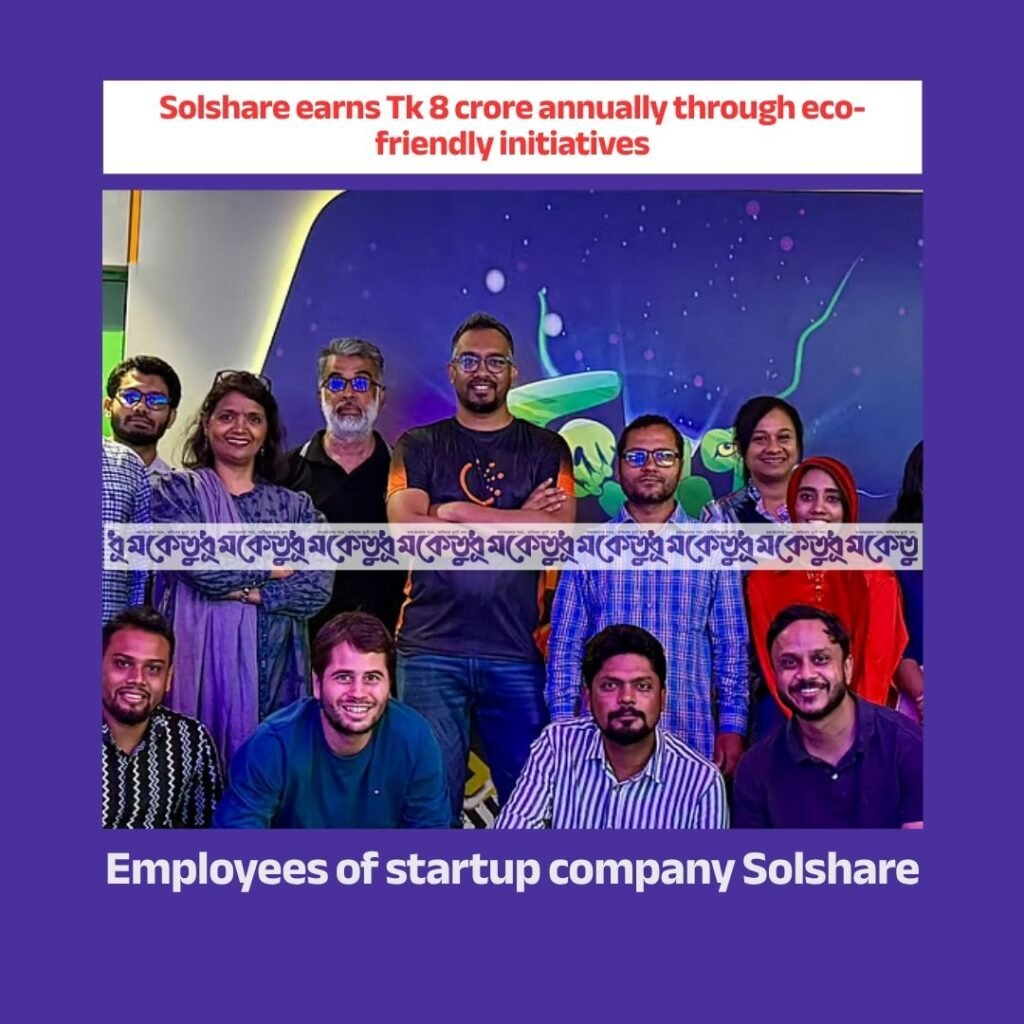
Employees of startup company Solshare
Mokarram Hossain, owner of Easy Bike Garage in Pubail Police Station, Gazipur. Last year, all the Easy Bikes in his garage were running on lead acid batteries. These lead acid batteries lost their performance within a year. So he thought of running Easy Bikes with lithium ion batteries. This also caused problems. Because the price of lithium ion batteries is high.
Considering the risk of investing in Easy Bike batteries, no bank or microfinance institution gives loans in this sector. In such a situation, the startup company Solshare helps the owner of Easy Bike Garage to get lithium batteries through bank loans.
Basically, the startup Solshare has separately connected an IoT (Internet of Things) chip to the lithium battery. Through this chip, Solshare can stop the charging and performance of this battery if it wants in the Pay As You Go (PAYG) model. Therefore, banks and microfinance institutions can also provide loans without risk.
This initiative of Solshare is called Solmobility. An easybike rider has to pay 10 thousand taka to avail this service. Apart from this, through Solmobility, a garage owner can also set up a solar-powered charging station without a one-time payment.
In this regard, Mokarram Hossain, owner of Easybike Garage, said that the use of lithium batteries is economical and the maintenance cost is low. As a result, income has increased by 20 percent. And through them, lithium batteries are being used without a large one-time payment.
However, Solshare has three other initiatives. One of its initiatives is called Solgrid. Through this technology, a solar power user can sell his unused electricity. And their other initiative is Solroof. Through this, any organization can install solar power technology through Solshare. This has developed Solshare’s business. For example, the company earned about 80 million taka in the 2024-25 fiscal year. And since its inception, it has received 7.7 million dollars in grants and awards.
Aziza Sultana, Deputy Executive Officer of Solshare, said, “Tesla and BYD may have sold 4 million electric cars worldwide. However, there are about 5 million easy bikes in our country. All of them have a storage for electricity. Currently, we have provided this technology service to about 300 easy bikes. These batteries return to the garage with 30 to 40 percent electricity. If this technology can be spread on a large scale, this electricity can also be used in the national grid through net metering in the future.”
Isa Abrar Ahmed, Director of Product and Commerce Department of Solshare, said, “A lithium-ion battery lasts for four years. However, its price is about two and a half times higher than a lead-acid battery. For this, we have arranged loans through various banks and financial institutions. And by adding our technology to this battery, we can control it. We can turn off the battery whenever we want.’
How SolShare started
SolShare started in 2014 with the SolGrid initiative. SolShare founder Sebastian Groh is a German citizen. He did his PhD on the role of energy in development, energy poverty and technological innovation. He came to Bangladesh in 2013 as part of his research. Sebastian Groh saw that there were about 4 million solar power systems in the country. About 30 percent of the solar power generated in these systems was not used. Then the idea of sharing solar power through a peer-to-peer (person-to-person) energy exchange network came to his mind.
The next year, i.e. in 2014, Sebastian Groh came back to Bangladesh and founded a startup company called Solshare. He started this initiative through IoT technology called ‘Sol Grid’. At that time, the company received a total investment of US $ 5 million. As a result of his initiative, marginalized communities got the opportunity to use electricity in areas where there is no electricity. However, in 2022, electricity service reached most of the country. As a result, the demand for this service decreased.
In 2022, a new initiative came up, ‘E-Mobility’. Then the company brought another initiative, Sol Roof. All brands and factories now have a goal of achieving net-zero carbon. However, the pressure to meet that goal is not small and it is also expensive. Technical expertise is also required in management. This is where Solshare provides benefits.
In addition, in 2023, Danish companies Bestseller and Solshare jointly launched the Greener Garments Initiative (GGI). Through this, any company can buy this technology from them if they want. Currently, no one can officially sell this unused electricity nationally. However, if there is a policy in this regard, it is possible to sell this electricity. So far, Solshare has installed 8 megawatt solar power plants. The process of producing another 8 megawatts is underway. In addition, Solshare will install another 100 megawatt solar power plants in the future.